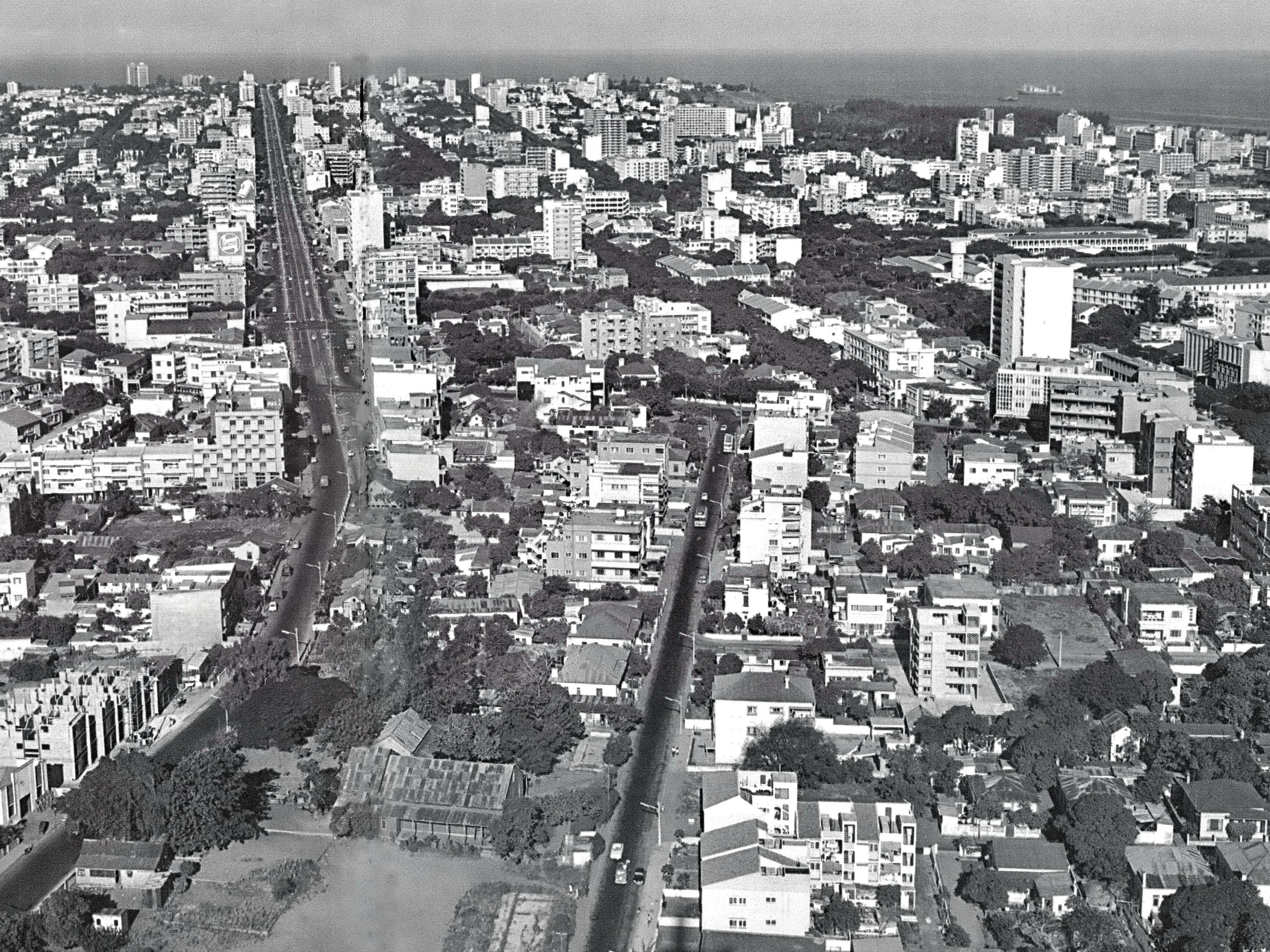
An aerial view looking north over the bairro of Alto-Maé, a blue collar suburb of Lourenco Marques. A little after Av. de Republica (Av. 25 de Setembro) was built and populated, the city’s planners decided to extended linkages with other parts of the city.
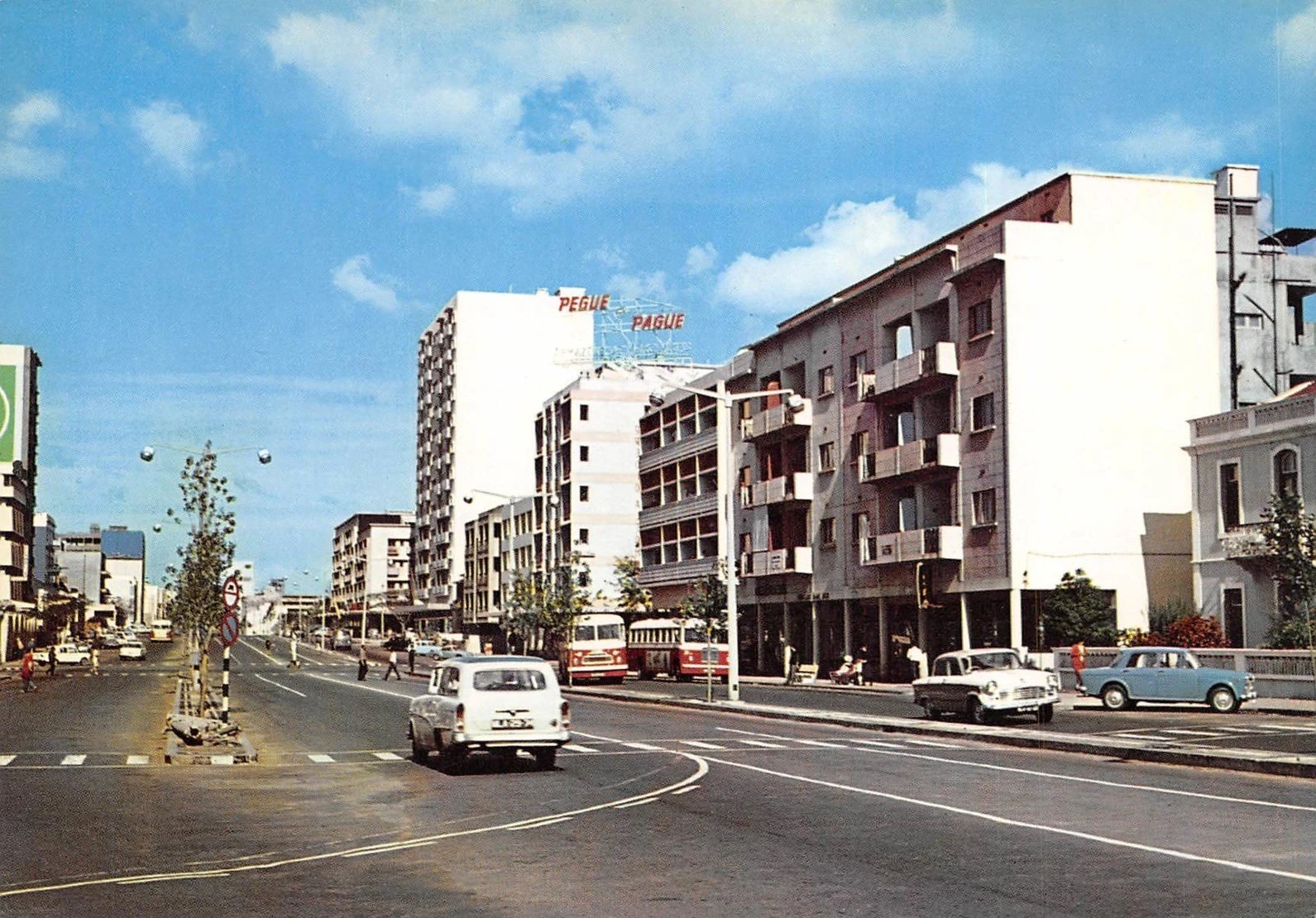
First going westward with the development of Av. Manuel de Arriaga (Av. Karl Marx) to connect the original commercial district, Baixa, with the outer suburbs. In the next phase of development a new connection was made between the eastern suburbs of Polana and the western suburbs through a new and very broad avenue such kind not built before, Av. Pinheiro Chagas (Av. Eduardo Mondlane). It is the only avenue in the city which has 4 center lanes and 1 lane at the far left and right as service roads.
It is said that the point at which the Bairro Central ends and Alto Mae begins is the intersection between Av. Eduardo Mondlane and Av. Guerra Popular (before: Av. General Machado); its namesake “Ponto Final” was a marisqueira (snack and beer bar) on the corner of that road.
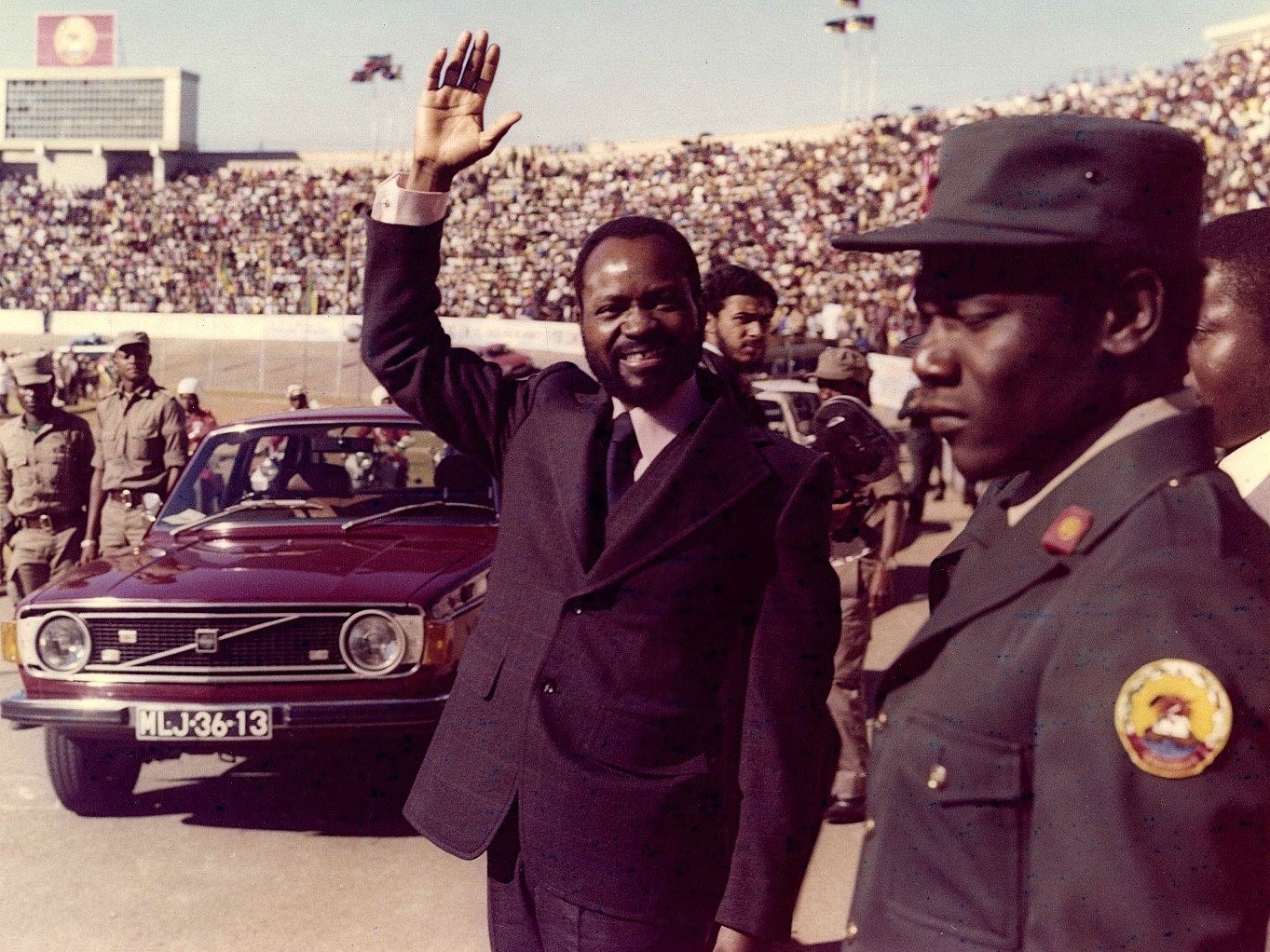
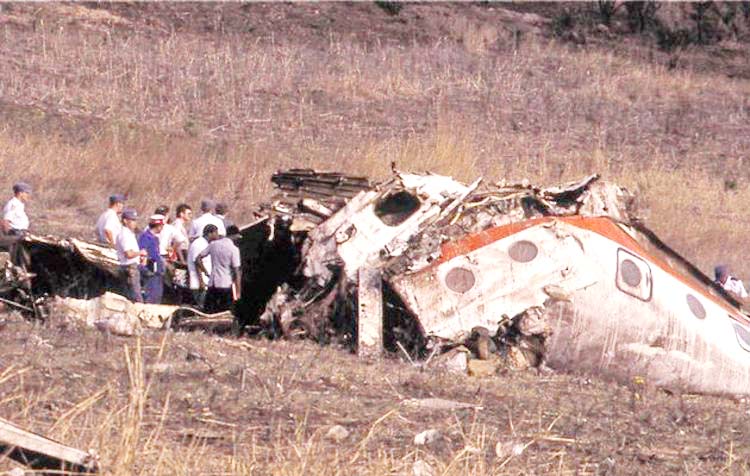
It has been 38 years since Mozambique’s first president died when his plane crashed one clear night near the mountains of Mbuzini. The sentiment of loss was palpable across the continent and if it was not, FRELIMO certainly did put out a showstopper of a state funeral to honour the man who unshackled the country from 500 years of Portuguese rule.
But more recent reflections of Machel suggest that the public’s perception is bittersweet. When the Portuguese flag was lowered on midnight of June 25th 1975, Mozambicans were convinced that an unheralded and prosperous future was within arm’s reach. The euphoria of change; persuasive catchphrases such as “A Luta Continua” belied the suffering that was to come.
Historians agree that the country made significant gains in the period 1975-1980, however, Machel was not content solely with a liberated Mozambique. He had turned his gaze over the borders to Zimbabwe and later South Africa, two veritable opponents led by minority white governments.
South Africa did not accept another state meddling in its affairs particularly as it tried to keep the ANC out. This resulted in it throwing its military prowess behind RENAMO. Birthed by the Rhodesian government and made up of a hodgepodge of disaffected people, it was swift in destabilizing Mozambique.
RENAMO’s main tactic was destabilization of the economy and the infrastructure that underpinned it. During the colonial area, railways and ports had been developed to allow transit out of Mozambique and also into it to the hinterland states of Zimbabwe and Malawi which generated enormous wealth for the country.
By 1983, Mozambique was in a ruinous state. The economy had hobbled along in the first years of independence but the civil war dashed hopes of returning it to a functional state. Trade deficit widened and the agricultural sector collapsed after two years of a particularly hard draught.
In Maputo Machel looked on as the country burned down, continuing the rhetoric of increasing productivity and publicly scolding RENAMO’s guerilla tactics. But it was clear to the public that FRELIMO and Mozambique were losing the war. What had started out as a child of Machel’s idealism – the liberation of Africa south of the Sahara was too costly of an investment.
With pressure mounting, the Nkomati Accord of 1984 demonstrated that Machel could be a pragmatic leader. In the agreement Mozambique would stop giving refuge to exiled members of the ANC and South Africa would halt its support to RENAMO. Much to Mozambique’s devastation, South Africa did not keep up its end of the agreement and the war continued.
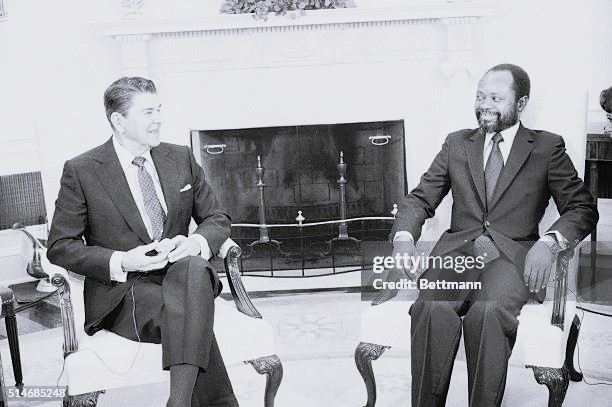
At what was the height of the cold war and with resources scant from Moscow, Machel went to the United States in September of 1985. Although conservatives in US had long lobbied then president Ronald Reagan to provide support to RENAMO, the US continued its position of “constructive engagement”.
If there was an inkling of hope that Machel could steer the country aright, it was delivered in the content of his speech that day at the South Portico of the White House. For the first time, Machel acknowledged that he was ready to accept private investment in the country. A feat of sorts for a hardline socialist. He explained that the country was endowed with vast mineral riches and looking for a partner to engage in exploration.
Despite his softening stance towards the West, Machel remained stubborn in the consolidation of the frontline states – those states working to undo apartheid South Africa’s stronghold in the region. When Malawi refused to join the SADCC, an irate Machel made plans to shut the borders and fire missiles into the country. Press reports of the time suggest that relations between Mozambique and South Africa hit an all-time low and that Machel was aware of a plot being devised to kill him.
Politicians and entertainers often share the same fate which is that while flying high on the back of good times their fall is often sudden and dramatic
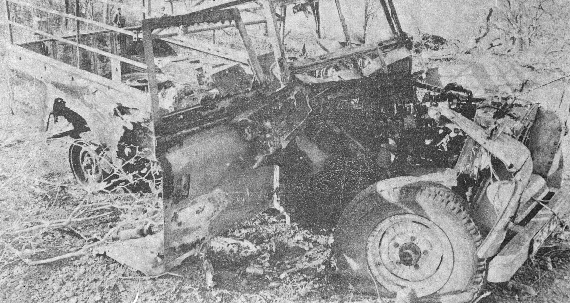
Years after the crash, the exact conditions of the downing of the plane are not clear. Initial reports had indicated that the Soviet pilots were drunk; other reports suggested that the South Africans developed a moveable navigation beacon to falsely guide the plane into the mountains. Even more sinisterly, the beacon at the airport in Maputo was switched off with the collaboration of Mozambican generals who wanted Machel dead.
The independence of Zimbabwe in 1980 deluded Machel into thinking he could repeat the scenario in South Africa. The highlights of 1984 and 1985 showed that Machel was trying to turn the tide but his adversaries had already charted a different path.
Machel left a lasting legacy of activism. Many of nation’s youth continue to listen to his speeches often in want of that which is missing in the political landscape of the country today. Although he had lead a movement that successfully overthrew colonialism, he spent the remaining years in office preoccupied in waging wars which brought about severe economic hardship and decline.
Politicians and entertainers often share the same fate which is that while flying high on the back of good times their fall is often sudden and dramatic.



 Terra Velha