

As the world becomes an increasingly complex place, with an unprecedented number of interactions occurring on every platform it becomes vital to ensure that we present our information making it relevant and easy to locate.
Google is no slouch. It has made billions of dollars off the concept of organizing information. Complex algorithms, which are accepted as trade secrets have not stopped inquisitive minds from trying to at least decipher these virtual magic tricks if not beat them at their own game.
But the notion of structuring data so that it can be used as information is an old one. You might even consider equating the job of a librarian, in modern times, to a telephone switch operator who would appear out of place in the world of towering gigahertz antennas supporting an elaborate cellular network.
Interestingly though you soon realize, as you delve into books on the subject, that the humble librarian could just as easily feel at home on a Google campus as they could in a dusty library. The point here is that information architecture is alive and well and can be applied to any project. It is one component of many which forms the bedrock of user experience (or UX) as we will see.
Defining context
The easiest way to understand iA in practical terms is to apply it to a project. The difference between an iA led effort versus non-iA can be like night and day. But iA can be applied more subtly, and applications can be so good that a high level of abstraction is imperceptible – the abstractions here referring to how seamlessly a user transitions from searching for content to finding and using it.
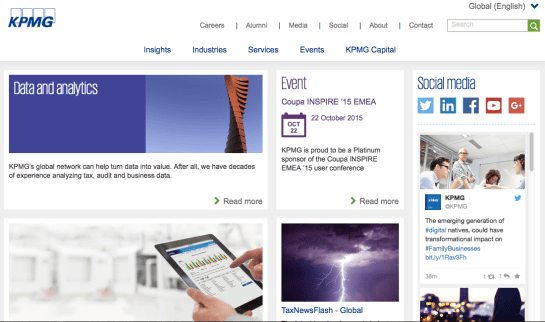
An online presence developed through effective use of iA (www.kpmg.com)

An online presence developed in a hurried manner with little use of iA
Following the guidance of Morville and Rosenfield, our first step is in defining context. This case involved developing a new site for a small auditing firm. The operating market is small, but the big four audit firms it generally competes with have seemingly infinite pools of talent and content developed internationally.
The quest of developing a compelling and competing online presence is out of question. There is simply no way a small firm with under ten full time staff could generate that level of relevant, local and tailored content.
But thinking locally, and engaging more directly is a strength of the company. Being small and nimble and relying on its existing connections allows it work just as successfully. Alliances with professional bodies affords it instant credibility which new clients may find comforting.
One final point, is that ultimately a client will choose an audit firm based on directives from standard guidelines or on a cost-based decision. This leaves the firm in the study worse off in the first instance, but better off in the second where it gets most of its business from.
The goals set in terms of context are:
- Rely on its image value-for-money service provider as a unique selling point
- Communicate the local context more effectively than others
- Create an attractive interface for new business
Defining content
Content is more than just presenting information as it is. When designing content based on iA principles for the web, the result is information which is consistent, easy to find and follow. These ideals are underpinned by tools which determine the how.
- Structure of the document
- Navigation
- Tools for search which maximize findability and
- Consistent use of language and terminology
There is always a small chance that content is consumed differently between users. It is a fact in much larger implementations where more content is presented. For this reason, every effort is made to adapt information to a variety of users.
Unsurprisingly, not only has content have to be modified but content may have to be served differently depending on where and how it is being accessed.
Special emphasis needs to be placed on the terminology used too. Best practices in iA suggest that users respond well to a controlled vocabulary.
The goals set in terms of context are:
- Balance the quantity of information and its findability
- Use multiple navigation systems to guide the user
- Allow content to be accessed independent of platforms or maximize device agnostic
Defining Users
The users are the audience of the site. We cater our content to those who are almost and most likely to read it. These two distinctions are made because overlapping content allows us to reach a wider audience.
A content that is too narrow can reduce its comprehensibility to all but subject matter experts. Similarly, content that is too broad will lack the specialty that keeps users interested.
As a result of these conclusions, several deepening sessions with audit professionals who may likely have a better understanding of how to present information would be quite valuable.
Features on the site which afford it some level of interactivity would rate it very highly. When a user can do much more than simply read, print and pass on information on the site it opens up new opportunities. The ability for the site to accept message from interested parties is one example of making the communication stream two-way.
The goals set in terms of context are:
- Define who our users are and cater the experience
- Use the right technical language to explain concepts
- Include interactivity which enhances the overall experience e.g. fast scrolling for long pages and messaging features directing comments directly to the stakeholders
Having established the goals of the project, in Part 2 we will look at the application of these principles correspondingly in terms of context, content and users.

 Terra Velha