
 The mid-twentieth century was shaped by significant cultural, political and religious turbulence. It was in this same century that the Cold War was born amid simmering tensions between the East and West; it was when the stirrings of racial inequity came to the fore in the United States of America and it was also when the Pan-African Independence efforts spearheaded the rapid and mass decolonization of African states. But there was also an enormous sense of order, progress and a drive to validate old structures that precipitated advances of the like which had not been seen before.
Lourenço Marques was the capital city of Mozambique, founded in 1897 it quickly rose to prominence as one of Portugal’s capital cities along with Luanda in Angola – another overseas province. At a time when growth and potential in Portugal had become limited, the overseas territories saw the injection of capital and attracted immigrants from the motherland. The country’s status as a colony made labour affordable and simplified access to land for development. Against the backdrop of a fascist Portugal, the colonies were seen as somewhat of a playground, a place where artists and musicians enjoyed greater liberties than elsewhere. Personal accounts by its former residents narrate a subtle endorsement of African cultures.
It is no surprise then that forward thought encouraged what was to follow. It is not known quite clearly what spurred the development of COOP but a combination of anti-political sentiment, disenchantment with traditional governing structures in Portugal and the vision of a new idealistically classless society are supposed to have been key influences. The net result of this was an enormous effort that unseated conceptions of colonialism inconspicuously. The COOP became known as a model enterprise, unbounded by political interests and clearly empowered by cooperative will.
Founding Principles
Like other co-operatives, the COOP was established and developed to function through a membership model. Certain levels of membership provided occupancy rights, while others allowed access to services such as bookshops. The COOP was designed to accommodate the large number of Portuguese middle-class settlers who were arriving into the country in the early 1960s. By the end of that decade it had well over 12,000 members. As a cooperative it also provided employment to its members, and even more interestingly counted on a membership base that included people not of European descent. It was project unlike others which was inclusive of the entire strata of the Mozambique population.
Architecture
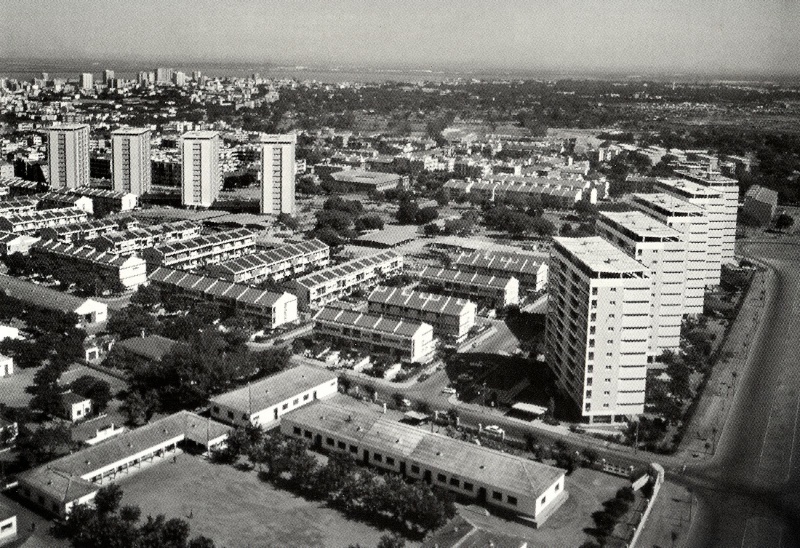
The bulk of the architectural work for the COOP was done around the same time in which the city was seeing rapid growth and urbanization. Several types of designs and structural innovations had their origins in Mozambique and the country was at the time a host to a number of preeminent architects and engineers such as Pancho Guedes, Joao Tinoco, Jose Forjaz and Jorge Valente who was to design the COOP.
The Bairro de COOP was located on a vast trapezoidal area in the north east of the city. This was an area with very little development at the time and was positioned quite close to the urban settlements that were built for non-Europeans. The intention was to make the location of the suburb as autonomous, self-reliant and considerably independent of the city – principals of the COOP project. The complete area would be able to accommodate about 8000 people and include several multistory towers and grounds for leisure such as parks and sports fields. The urban space for the complex while unique to Mozambique, heavily borrowed from plans already established in other densely populous parts of the world.
Post Independence & Identity
Construction of the first towers were completed by the early 1970s but by then the clashes between the colonial government and FRELIMO – an armed group fighting for independence from Portugal had become too obvious to ignore. The situation worsened in 1974, a bloodless coup in Portugal saw a change in power which eventually led to independence and by 1975 most Europeans had left the country.
The COOP however up to this point was able to continue motivating its members and had been able to receive the support of several banks due to its founding principles which expressly advocated the beneficiaries of the project as common folk, its impartiality to racial background and class and ideas of achieving societal transformation through the use of living spaces. It was perceived as a lesser evil by the Marxist/Communist government that was to lead the country post-independence.
 Terra Velha